


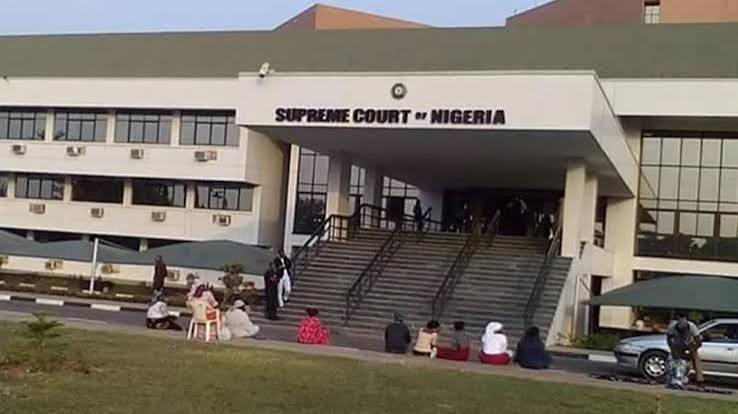
The Supreme Court will hear an appeal by Oluwatimehin Adelegbe challenging the judgment that recognised Abdulghani Arobo as the All Progressives Congress (APC) candidate for the 2027 Owo/Ose Federal Constituency House of Representatives election in Ondo State.

In his appeal, Adelegbe asks the Supreme Court to overturn the Oct. 9 judgment of the Court of Appeal in Abuja.
Adelegbe claims he won the APC primary on May 16 and was properly nominated as the party’s candidate. This forms part of his appeal to the Supreme Court.
Listed as respondents in the appeal are Arobo, the APC and the Independent National Electoral Commission (INEC).
In his notice of appeal, Adelegbe challenges the Court of Appeal’s refusal to admit evidence showing he won the primary and that the APC submitted his name to INEC as its candidate.
He also contests the appellate court’s decision in appeal CA/ABJ/CV/1235/2026, which upheld the Aug. 5 judgment by Justice Peter Lifu of the Federal High Court, Abuja, recognising Arobo as the APC candidate.
Adelegbe’s legal team, led by Joseph Daudu, SAN, filed 18 grounds of appeal before the Supreme Court.
Adelegbe seeks to have the Supreme Court allow his appeal and set aside the Oct. 9 interlocutory orders and the Court of Appeal’s judgment.
He also requests an order from the Supreme Court directing INEC to recognise, publish, and maintain his details as the duly nominated APC candidate for the Owo/Ose Federal Constituency in the next general elections.
In his first ground of appeal, he argues that the Court of Appeal erred in law and caused a miscarriage of justice by refusing his motion, under Order 4 Rule 2 of the Court of Appeal Rules 2021, to present additional evidence.
Adelegbe listed the additional evidence as statutory public documents, including the APC official candidate forwarding letter dated June 26, his Form EC9 affidavit, the INEC Candidate Nomination Portal submission receipt dated July 11, and a certified true copy of the APC Election Committee result sheet showing he received 13,094 votes.
He maintains that if Arobo had joined him as a party in the suit leading to the Aug. 5 judgment, he could have presented sufficient evidence to prove he was declared the winner of the APC primaries for the Owo/Ose Federal Constituency.
The appellant argues that under Order 4 Rule 2 of the Court of Appeal Rules 2021, the appellate court has discretion to admit further evidence, especially when such evidence could not be produced at trial due to his exclusion or other special grounds.
Adelegbe alleges that Arobo intentionally excluded him from the trial court proceedings.
He further argues that unlawful exclusion and non-joinder of a necessary party at the lower court represent the highest level of “special grounds” under Order 4 Rule 2, as a party unaware of proceedings cannot be faulted for not submitting documents during a trial from which he was excluded.
He also argues that the Court of Appeal erred in law and made a perverse decision by affirming the trial court’s judgment.
He states this breached Section 36(1) of the 1999 Constitution and was done without joining him as a necessary party, based on the incorrect finding that no final declaration or return had been made in his favour.
The appellant further asserts that the appellate court erred in law by holding that he was bound by the trial court’s proceedings under the doctrine of “standing by” and that the APC adequately represented his interests. He argues that the doctrine of estoppel by “standing by” necessitates clear proof that the non-party had actual notice of the suit, a direct interest in the matter, and knowingly chose to let others represent his interests.
He added that the Court of Appeal erred in law by holding that Arobo was justified in bypassing the APC National Working Committee after waiting 11 days.
The appellant also challenges the appellate court’s finding that Arobo’s suit was properly commenced by originating summons under Paragraph 7(1) of the Pre-Election Practice Directions 2026, despite serious and conflicting factual allegations in the case.