


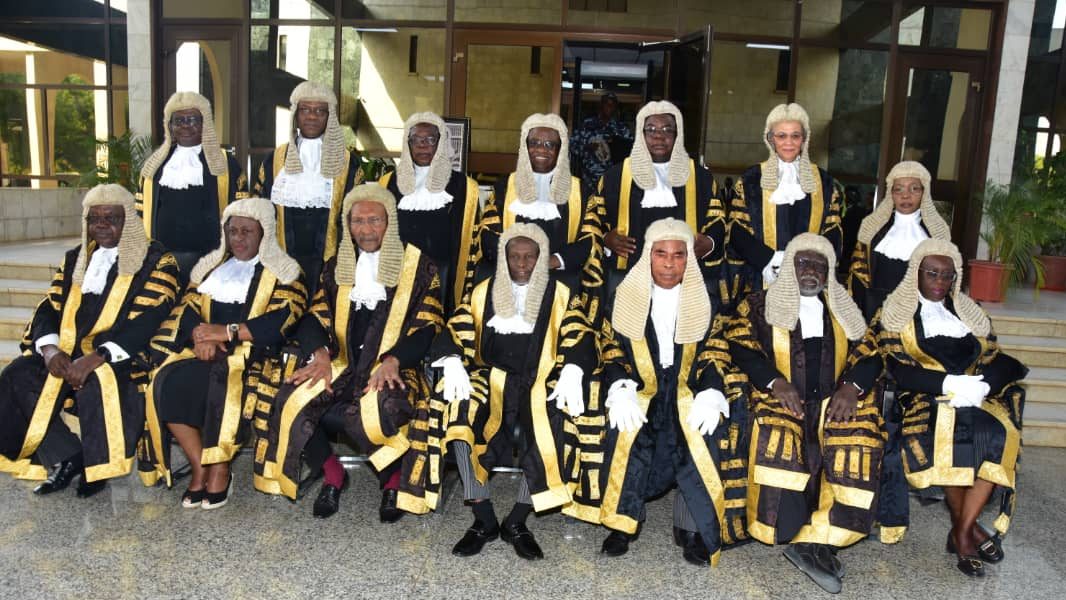
A recent intervention by Ibadan-based legal practitioner, Mr. Olakunle Akintola, calling for a restriction of the Supreme Court’s appellate jurisdiction to constitutional and criminal matters, has once again brought into sharp focus a long-standing structural challenge within Nigeria’s judicial architecture and the overwhelming burden placed on the apex court.
His proposal is not merely administrative; it raises fundamental constitutional questions about the role of the Supreme Court in a modern democracy and whether Nigeria’s current system aligns with global best practices.

The Problem of Judicial Congestion at the Apex Court
Nigeria’s Supreme Court today sits as a court of both final appeal and routine error correction, entertaining a vast range of civil, commercial, and interlocutory matters. This expansive jurisdiction has resulted in:
- A severe backlog of cases
- Delays spanning several years before final determination
- Judicial fatigue and reduced quality of deliberation
- Limited time for the resolution of truly significant constitutional questions
In practice, the apex court is inundated with appeals that, in many jurisdictions, would terminate at intermediate appellate courts.
Akintola’s argument that not all appeals from the Court of Appeal should proceed to the Supreme Court is therefore both pragmatic and jurisprudentially sound.
Comparative Perspectives: The United States Model
In the United States, the Supreme Court of the United States operates under a certiorari system, which allows it to exercise discretionary jurisdiction over the cases it hears.
Out of thousands of petitions filed annually, the Court selects only a small fraction, which are typically fewer than 100 cases, for a full hearing. The criteria for selection include:
- Constitutional interpretation
- Conflicts among lower courts (circuit splits)
- Issues of national importance
This filtering mechanism ensures that the Court is not bogged down by routine appeals but instead focuses on shaping constitutional doctrine and maintaining legal coherence across the federation.
The result is a highly efficient apex court that delivers authoritative and timely judgments on matters of national significance.
The United Kingdom Approach: Permission to Appeal
Similarly, the Supreme Court of the United Kingdom employs a “permission to appeal” system.
Under this regime, appeals are only entertained where they raise:
- Arguable points of law of general public importance; or
- Issues requiring clarification of existing legal principles
This gatekeeping function ensures that the Court’s docket is reserved for cases that contribute meaningfully to the development of the law.
Nigeria’s Open-Door Approach: A Structural Anomaly
By contrast, Nigeria’s constitutional framework, particularly under Section 233 of the 1999 Constitution (as amended), provides for broad rights of appeal to the Supreme Court, including as-of-right appeals in numerous categories of cases.
While this approach reflects a commendable commitment to access to justice, it has inadvertently produced a system where:
- The apex court is overburdened with routine litigation
- The distinction between error correction and law development is blurred
- Litigants pursue appeals to the Supreme Court as a matter of course, rather than necessity
The consequence is a judiciary struggling to balance accessibility with efficiency.
The Case for Constitutional Reform
Akintola’s proposal aligns with a growing consensus among legal scholars and jurists that Nigeria must transition from a right-based appellate system to a more filtered, discretionary model.
Such reform could take several forms:
- Limiting appeals as of right to constitutional and criminal matters
- Introducing a leave-to-appeal requirement for civil and commercial cases
- Establishing clear criteria for Supreme Court review, focusing on issues of national or jurisprudential importance
These reforms would require constitutional amendment but are essential to reposition the Supreme Court as a true constitutional court, rather than a general court of last resort.
Beyond Jurisdiction: Holistic Judicial Reform
While jurisdictional reform is critical, it must be complemented by broader institutional changes, many of which Akintola rightly identified:
- Financial autonomy for the judiciary, particularly at the state level, to safeguard independence
- Merit-based judicial appointments, to enhance competence and integrity on the bench
- Digitalisation of court processes, to reduce delays and improve efficiency
- Strengthening local governance and security frameworks, including state policing and local government autonomy
These reforms are interconnected and necessary to rebuild public confidence in the justice system.
Restoring Public Confidence Through Structural Efficiency
Public trust in the judiciary is inextricably linked to its ability to deliver timely, fair, and credible justice. Delayed justice, congested dockets, and perceptions of inefficiency undermine the legitimacy of the courts.
Encouragingly, ongoing reforms under the leadership of the Chief Justice of Nigeria, Hon. Justice Kudirat Kekere-Ekun, signal a recognition of these challenges. However, without addressing the structural issue of the Supreme Court’s jurisdiction, such reforms may yield only limited results.
Conclusion: Time for a Paradigm Shift
Nigeria stands at a critical juncture in its judicial evolution. The question is no longer whether reform is necessary, but how bold and far-reaching such reform should be.
Restricting the Supreme Court’s jurisdiction is not about limiting access to justice; rather, it is about preserving the integrity, efficiency, and constitutional role of the apex court.
As comparative experience from the United States and the United Kingdom demonstrates, a well-filtered appellate system is essential for any judiciary that seeks to balance accessibility with excellence.
The time has come for Nigeria to embrace this paradigm shift.