


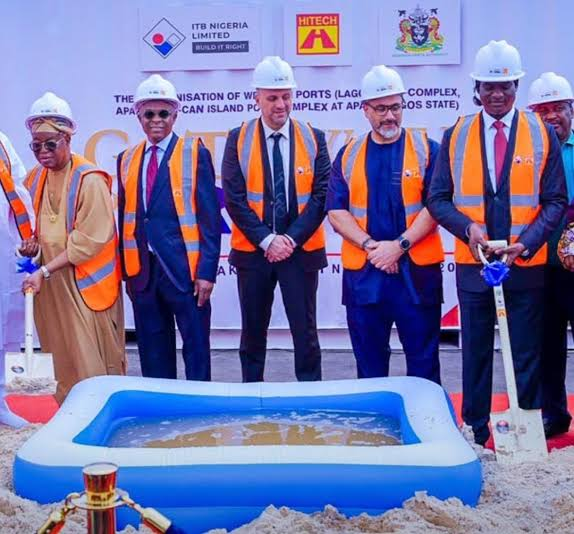
The Federal Government on Wednesday flagged off the modernisation of the Lagos Port Complex, Apapa, and Tin Can Island Port to reposition Nigeria for national development and as a leading maritime hub in Africa.
The Minister of Marine and Blue Economy, Dr Adegboyega Oyetola, led the ceremony at Tin Can Island Port alongside Finance Minister Taiwo Oyedele and senior government officials in Lagos.

This is contained in a statement by the Special Adviser to the Minister of Marine and Blue Economy, Dr Bolaji Akinola, on Wednesday.
According to the statement, the project costs 746 million pounds, approximately 1.45 trillion Naira, and will address decades of infrastructure deficits at both major ports to support national development.
The statement quoted Oyetola as saying the modernisation would reduce logistics costs, attract international shipping lines, stimulate industrial growth, and create at least 20,000 direct and indirect jobs to support national economic growth and development.
Furthermore, the Minister described the programme as a significant step toward realising President Tinubu’s Renewed Hope Agenda, which prioritises infrastructure development for economic growth and investment.
He noted that Apapa Port, established in 1913, was more than a century old, while Tin Can Island Port was commissioned in 1977 to further national economic growth and development.
“At commissioning, Nigeria’s population stood at approximately 67.2 million; annual trade was about 17 billion dollars, and cargo throughput was eight million tonnes.
“Nigeria’s population has grown to approximately 240 million; merchandise trade exceeds one hundred billion dollars annually across all sectors.
“Cargo throughput has increased to 129.3 million metric tonnes, nearly 16 times its 1977 level nationwide”.
The statement said Oyetola explained that the mismatch between growing economic activities and ageing port infrastructure has made comprehensive modernisation urgent and unavoidable for national development, economic growth, and investment today.
He warned that the cost of inaction was far greater than the cost of modernisation, adding that Nigeria would not surrender its competitive advantage to neighbouring countries.
It noted that the Minister lamented cargo dwell time at Nigerian ports, which ranged between 10 and 18 days, compared with three to five days at leading international ports.
He said these inefficiencies cost the Nigerian economy as much as four billion dollars annually through congestion, demurrage, storage charges, and higher logistics costs for traders.
According to the statement, Oyetola said the project will rehabilitate quay walls and berths, dredge navigation channels, and improve access facilities, cargo-handling equipment, and operational systems for efficient, digitally enabled operations.
The statement noted that the Minister approved an Inter-Ministerial Committee comprising the Ministry of Marine and the Ports Authority and Regulatory Agency to develop a port business continuity and cargo flow management plan.
The statement also noted that the Managing Director of the Nigerian Ports Authority (NPA), Dr Abubakar Dantsoho, described the groundbreaking as a landmark moment in NPA’s history.
He reaffirmed commitment to delivering the project according to approved designs, standards, and timelines in Lagos.
He assured stakeholders that NPA would maintain robust technical supervision, quality assurance, and effective coordination throughout construction, with particular attention to safety, environmental standards, and continuity of operations.
The ceremony was attended by Poland’s Deputy Foreign Minister, Marcin Bosacki; Polish Ambassador to Nigeria, Michal Cygan; and British Deputy High Commissioner in Lagos, Jonny Baxter, alongside contractor partners and stakeholders.