

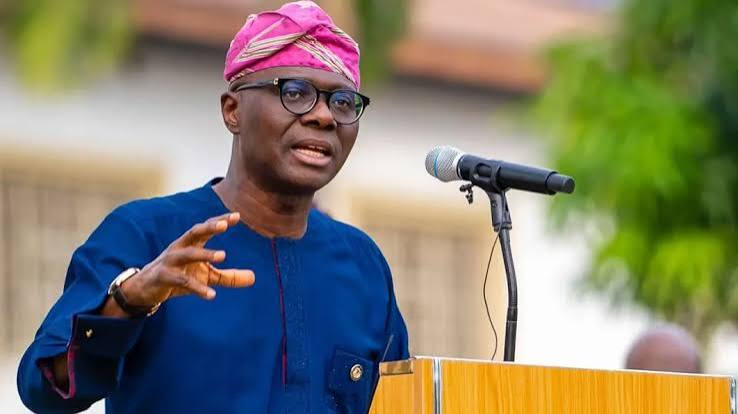
Gov. Babajide Sanwo-Olu of Lagos State said the state aims to achieve an economy valued at between $800 billion and $1 trillion by 2052.
He noted that growth in manufacturing, value addition, exports, and investment will drive this goal.

Sanwo-Olu, represented by the Secretary to the State Government, Mrs Abimbola Salu-Hundeyin, made this statement at the closing ceremony of the 40th Lagos International Trade Fair.
Sanwo-Olu said that Lagos was working to move beyond being a major centre for buying and selling to becoming a stronger hub for production and exports.
He added that more locally made products will compete in African and international markets. The state is committed to supporting businesses through improved infrastructure, access to affordable finance and a better business environment.
“The commitment informed the Lagos State Industrial Policy 2025–2030 and other initiatives aimed at promoting enterprise development,” the governor said.
Sanwo-Olu explained that the government is expanding access to affordable capital for cooperative-backed businesses through the N10 billion Lagos State Micro Enterprise Cooperative financing arrangement. added that the state was investing in transportation, electricity reform and other infrastructure to improve the business environment.
The governor described Lagos’ recognition as Nigeria’s best-performing state in the 2025 Presidential Enabling Business Environment Council Subnational Ease of Doing Business assessment as encouraging. said, however, that more work was needed.
He noted that the African Continental Free Trade Area (AFCFTA) offers significant opportunities for Nigerian businesses and emphasised the need for competitive products, reliable infrastructure, access to finance, and stronger business networks. Nwo-Olu urged the Lagos Chamber of Commerce and Industry to sustain the trade fair as a platform for export development, industrial partnerships and investment in local production.
He also encouraged exhibitors and participating businesses to strengthen the relationships formed during the 10-day fair. said, “Investments should measure their success by the markets opened, businesses expanded, and jobs created.”
Earlier, Commissioner for Commerce, Cooperatives, Trade and Investment, Folashade Ambrose-Medebem, reported that over 50,000 participants, thousands of exhibitors, and business delegations from more than 20 countries attended the 10-day fair. She said the state trained more than 2,000 Lagos-based Micro, Small and Medium Enterprises (MSMEs) in export readiness and market access, in partnership with Afreximbank and other organisations.
According to her, the training is designed to prepare local businesses to benefit from the AfCFTA, which offers access to a continental market of at least 1.4 billion people. The commissioner said that Lagos would lead a delegation of local businesses to China through its Export Readiness Programme to explore international markets and build partnerships.
She also announced that Lagos will host the Intra-African Trade Fair 2027 from Nov. 5 to Nov. 11, expecting to attract over 100,000 visitors and 2,500 exhibitors from more than 100 countries. She said the event was expected to generate $50 billion in trade and investment deals.
Ambrose-Medebem disclosed that Lagos attracted more than one trillion naira in investments in 2025, with commitments in technology, healthcare, logistics and port operations.
She stated that the state contributed 30 per cent of Nigeria’s Domestic Product in the first half of 2024, according to the Lagos State Economic Development Update. The commissioner said the government was also investing in infrastructure, including the blue and red rail lines, expanded road networks, the Lekki Deep Sea Port, and the Lekki Free Zone.
She explained that these investments aim to improve connectivity and support manufacturing and trade. He added that the ministry facilitated business-to-business matchmaking, supported MSMEs seeking new markets and showcased locally made products through the Lagos State Pavilion.
The commissioner encouraged Nigerian businesses to improve product quality, adopt technology, and meet international standards to compete effectively in African and global markets. He commended the LCCI for sustaining the trade fair for 40 years, describing it as an important platform for businesses to establish partnerships, attract investment and explore new markets.