


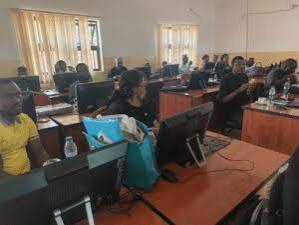
A cross-section of the Supreme Court staff members on Wednesday at a five-day training in Karu, Nasarawa State.
To safeguard its vital information, the Supreme Court of Nigeria has commenced training for no fewer than 50 of its staff members in the Information and Communications Technology (ICT) Department on data protection techniques.

The five-day training, organised in Karu, Nasarawa State, is being facilitated by Eleven One Bytes Limited, a Nigerian technology consulting and cybersecurity firm.
Speaking on Wednesday, a training facilitator with the consulting firm, Mr Eche Christopher, said the workshop aims to upskill the apex court workers in ICT-related fields to protect against cyber threats.
“ICT staff are core staff who manage the digital assets of the Supreme Court of Nigeria.
“Due to the sensitivity of their job, it is good that they are aware of cyber threats out there, and they are also aware of the data protection methods they can use to protect the Supreme Court data from unauthorised access.
“So basically, this course is to help them guard against cyber incidents; preventive measures as well as corrective measures.
“Corrective measures in the sense that when incidents occur, how do they respond to the cyber incident that has occurred? So this course will address those issues,” he said.
Christopher, a certified Ethical Hacker, stressed that the training is important because an ICT staff member could be an entry point for a cyberattack if they fail to secure a personal system assigned to them.
He said a worker who falls victim to a suspicious phone call or email could also be an entry point for a cyberattack.
He listed some of the courses to be taken as incident response, social engineering, threat detection, vulnerability analysis and assessment, penetration testing, etc.
Dahiru Abubakar, an Assistant Chief Programme Analyst in the court’s ICT Department, said the training ought to have been held earlier because the court is currently going digital.
He said the training should not be for ICT staff alone but for the entire court staff, because everyone needs to know how to safeguard the court’s data in all forms, whether as a user or a manager.
“We need to know the threats and the mitigation to these threats so that we can protect the data because the court is having sensitive data that is not supposed to be allowed by hackers to penetrate,” he said.
He said the training would go a long way toward helping staff with partial or theoretical knowledge of ICT and data protection understand how to apply it.
“Meaning, it is going to help a lot of staff who have already passed through university; they know the theoretical part but have not been able to practise it in reality itosafeguard the data of the court,” Abubakar said.
Mr Henry Orihe, a Network Engineer with the Supreme Court, said the training would help him secure the court’s network, which holds vital information.
According to him, the training will give him vast knowledge of how to secure the network.